Showing posts with label taking turns. Show all posts

Sunday, August 16, 2020

10 Ways to Keep Kids Busy at Home


1. An obstacle course is a versatile and potentially cheap way to keep kids of all ages occupied.  It can be modified for different skill levels, promotes gross motor skills, and can be indoors and outdoors.

2. Bubbles delight kids of all ages.  Even an infant, can practice tracking as he follows them with his eyes.  Trying to catch bubbles promotes hand-eye coordination and exercise of the pincer grasp.  Bubbles can be created with everyday items in a multitude of ways and are a great avenue for experimentation.  For instance, bubbles can not only be be tiny or gigantic, but even scented!


3. Making puppets encourages creativity and builds fine motor skills.  Kids can then use the puppets for storytelling, which boosts language and can be a way to facilitate social skills learning.


4. Make a blanket fort.  Yes, this is what you used to do as a kid, and yes, it is still fun!  Forts are adventurous and provide a quiet space for reading, playing, and resting.  The best part - you already have everything you need right at home!


Pinterest Pick!


5. Keeping the balloon (or balloons!) in the air is just plain fun!  It also encourages hand-eye coordination and can be a super team-building activity.  As simple as blowing up one balloon or as complex as creating "racquets" or using a sheet or parachute, balloons are enticing to toddlers and reluctant teens alike.  (Make sure any broken pieces are thrown away!)

6. "Free art" is simply setting out art supplies and letting kids make whatever they want.  Many kids don't like preplanned crafts, and even those who do appreciate time to invent and draw.  This is a great activity to do with your kids and works best when you resist the urge to "help" - unless a meltdown is imminent, of course!  


7.  Hide-and-Seek is a classic, sure to bring out the giggles in its participants.  Played individually or in pairs, it offers a good opportunity to practice helping, problem-solving, and self-control.  


8.  Playing “store” or “restaurant” might require some imagination, but it is a well-loved pastime that is adaptable to different skill levels and attention spans.  From cooking and a specially designed menu to following the random instructions of a 2 year old, creativity is the goal at play. 


9. Freeze dance uses the power of music and movement to foster expression, confidence, and good listening skills.  It can even be done in the car to distract kids from the inevitable bickering!


10. Follow the leader can be done anywhere, anytime, and allows for confidence building and leadership development, creativity, and practice taking turns.  It is a great distraction method to help kids refocus.


Wednesday, March 18, 2020

Love to Learn - Toss Games

Toss games are a fun way to improve hand-eye coordination and concentration, learn and review content, and practice social skills such as taking turns and following directions. They are very versatile and can be as simple or fancy as you desire. They can be played alone or with others and tend to entice people of all ages.

Use buckets, boxes, baskets, bowls, or anything else you can find (you can even draw circles in chalk or use paper “targets”) and toss rings, bean bags, balls, or even rolled up socks to create a custom toss game. Line up the targets either in a line or random pattern and label them with point values, actions, etc....A toss then either happens as a result of answering a question correctly or causes something to happen (like gaining points or winning a prize).


Here are some examples:


1.  Read a sight word or answer a question, and get a turn to toss.
2.  Label the targets with story characters and aim for the one that is asked about.
3.  Match a number symbol with its written form. Label the targets with words and the item to       be tossed with the number symbol or vice versa. This also works with upper and lower case         letters.
4.  Match math facts with answers.  This is a good way to limit the number of problems worked       on at a time.  Any question-answer combination would work.
5.  Higher level questions might include vocabulary, amendment numbers, and geography.
6.  Without questions,  make a toss game that fits with a specific theme.

*Note:  For your convenience, I have included Amazon links, however, it has been my experience that many of these things are available at Dollar Tree or can be substituted with items already in your home.

Incorporate teamwork with this human ring 
toss which makes use of inflatable pool rings.

This game uses paper plates
and coordinating bean bags.

Reuse your plastic bottles with pipe cleaner rings.
Each team tries to get their ball in the other
team's buckets.  This could be used with 

only one bucket or even more.  
Sight words are written and circled
in chalk.  The cards indicate which
sight word to throw the bean bag at.
In this version, sight words are written
on different color water balloons.
 
This themed toss game,
uses cotton balls or fake
snowballs to fill a pop-up
hamper decorated like a
snowman. So cute!


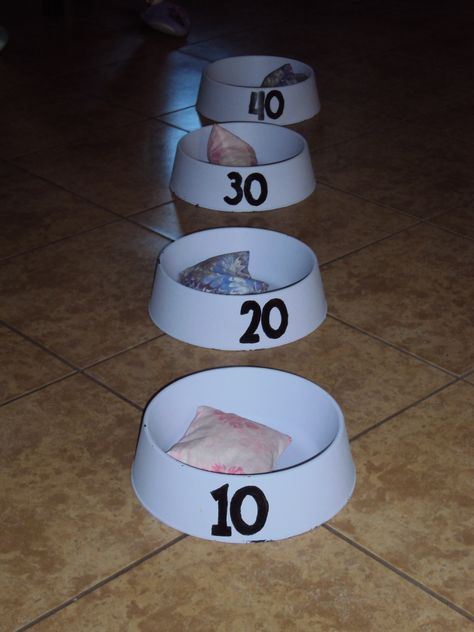
Bean bags and dollar store dog
bowls are sure to make this puppy
themed toss game a hit!

I love the idea of using Duplos as targets and 
pipe cleaners as rings! 
**Word of caution: The Lego towers fall easily 
and could become quite frustrating. **
Decorate individual cones 
(buckets, bowls, etc..) to fit 
with your theme.  
I've done this before 
for birthday parties.
Simple paper plate rings and
paper towel roll targets make 
this an easy, cheap, and
disposable game.
Brightly colored buckets are 
each labeled with increasing 
point values.